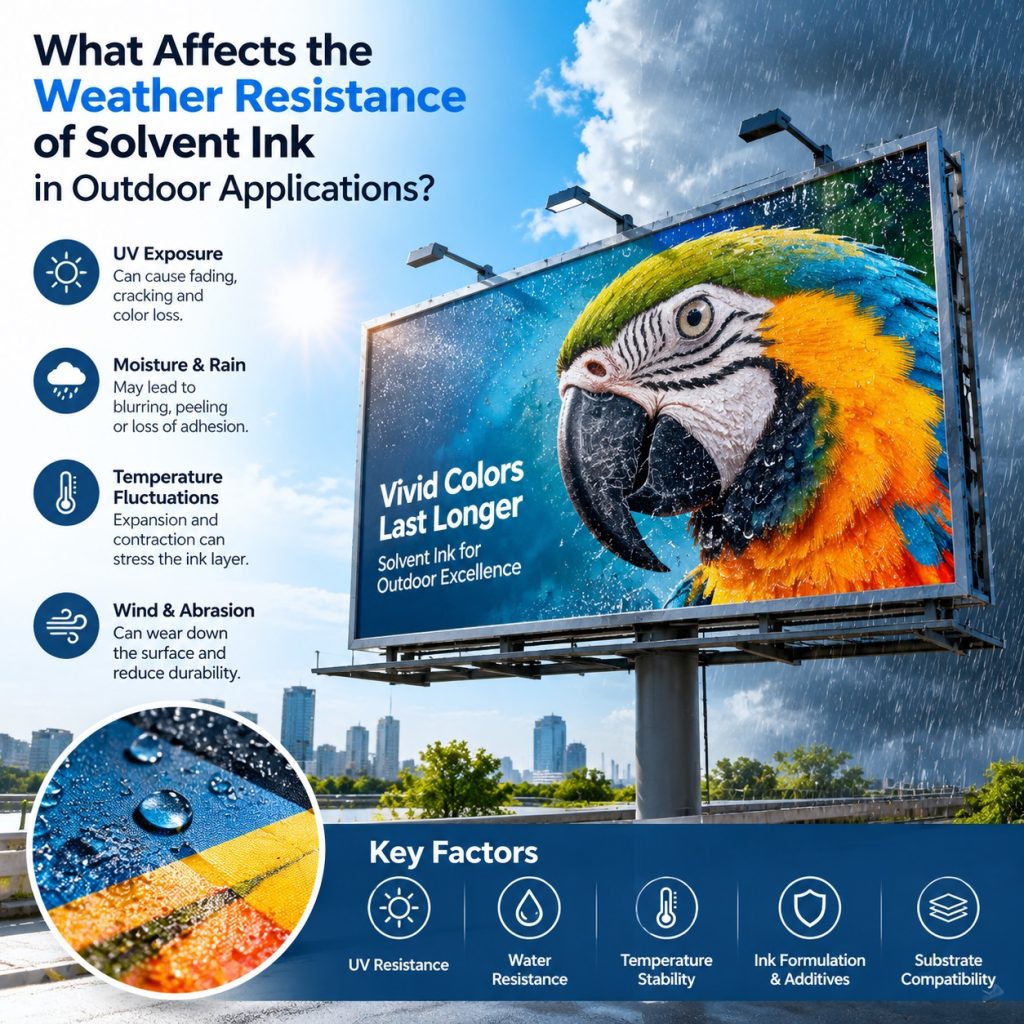
 A solvent ink that looks bulletproof in the shop can turn chalky, faded, or sticky after ninety days on a south-facing wall. The culprit is rarely one thing. Weather resistance is a chain, and the weakest link decides how long your graphics survive. If you sell outdoor signage, vehicle wraps, banners, or industrial labels, that chain is your reputation.
Start with resin. Resin is the backbone of the dried ink film. It holds pigment in place, sticks to the substrate, and takes the first hit from ultraviolet light, moisture, heat, and pollution. A cheap resin may save a few cents per liter, but it can crack, chalk, or lose adhesion long before the warranty ends. High-performance solvent inks usually lean on tougher polymer systems, such as polyurethane, acrylic, or vinyl copolymers, chosen for the specific outdoor job. The resin also has to stay flexible on vinyl and rigid on metal. One resin cannot do everything well, no matter what a bargain-bin datasheet claims.
Pigments are the next weak point. Organic pigments can be vivid and clean, but some fade fast under UV. Inorganic pigments tend to hold color longer, though they may be duller or more expensive. Red, yellow, and some oranges are notorious for early fading. A formulator who cares about outdoor performance chooses lightfast pigments and tests them in real sunlight, not just under a lab lamp for a week. If your customer’s brand color drifts after one summer, the ink failed, not the printer.
The solvent package matters more than most people admit. Solvents carry resin and pigment, then they leave. If they evaporate too quickly, the film may not form properly and adhesion suffers. If they linger too long, trapped solvent can soften the film, attract dirt, and cause blocking. The right blend also helps the ink wet out the substrate and lay down a uniform film. Cheap solvent blends can smell worse, dry unevenly, and leave the print vulnerable. Weather resistance starts with a film that formed correctly in the first place.
Additives are the quiet bodyguards. UV absorbers and hindered amine light stabilizers slow the breakdown of resin and pigment. Antioxidants help against heat and oxygen. But additives are not magic dust. They can migrate, react with other ingredients, or fail if the resin system is weak. A good ink manufacturer balances the whole recipe. A bad one throws in a little UV package and hopes the customer never runs a real exposure test.
Substrate and adhesion decide whether the ink gets to fight another day. Ink cannot protect a surface it does not stick to. PVC, polycarbonate, treated polyethylene, aluminum, and coated metals all behave differently. Surface energy, primers, corona treatment, and cleaning before printing can make or break performance. If the substrate chalks or expands and contracts, the ink film may go with it. The best solvent ink on the wrong substrate still fails. The worst ink on a perfect substrate fails faster.
Curing and film thickness are operator-controlled variables that deserve more respect. Undercured ink is a time bomb. Too thin, and UV light punches through to the substrate. Too thick, and solvent gets trapped, the film cracks, or edges lift. Printer heat, airflow, print speed, and pass count all shape the final result. A shop that ignores these settings can blame the ink all day, but the weather will expose the truth.
Then there is the weather itself. UV intensity, rain, humidity, salt spray, temperature swings, ozone, pollution, and abrasive dust do not treat every location equally. Arizona sun is not Seattle rain. Coastal air is not inland factory air. A fleet in Florida faces different stress than a construction sign in Norway. Cleaning chemicals and pressure washing add another layer of punishment. An ink that performs well in one climate may need a different formulation, clear coat, or overlaminate in another.
Color and ink laydown also change the outcome. Dark colors absorb heat and can accelerate degradation. White underbase and heavy ink coverage can protect or trap stress depending on the system. Spot colors, process colors, and flood coats all behave differently. A clear coat or quality overlaminate can add years by blocking UV and resisting abrasion, but it cannot rescue a weak ink film underneath.
Manufacturing consistency is the invisible factor. Two batches of the same ink can perform differently if resin suppliers, pigment dispersions, or QC tolerances slip. Accelerated weathering tests, such as QUV and xenon arc, are useful, but real-world exposure in Florida or Arizona tells a harsher story. Ask your ink supplier for outdoor exposure data, not just a glossy brochure. Ask how they control batch variation. Ask what happens when a customer reports fading after six months.
Storage and shelf life matter too. Ink that sat in a hot warehouse or froze in transit may never cure or adhere correctly. Contamination from dirty lines, old ink, or incompatible cleaners can ruin a good batch. Simple housekeeping protects weather resistance more than many printers realize.
So what should a buyer do? Treat solvent ink as a system, not a commodity. Look at the resin, pigment, additive package, solvent blend, and the supplier’s testing discipline. Match the ink to the substrate, climate, and expected lifespan. Control curing, film thickness, and lamination. Then verify performance with your own outdoor tests before promising a five-year warranty.
Weather resistance is not one ingredient. It is a chain of decisions from formulation to final print. If you are tired of reprints, faded fleet graphics, and angry customers, stop shopping on price per liter alone. The cheapest ink is the one that still looks good after two summers, not the one that saves a few dollars on the invoice.