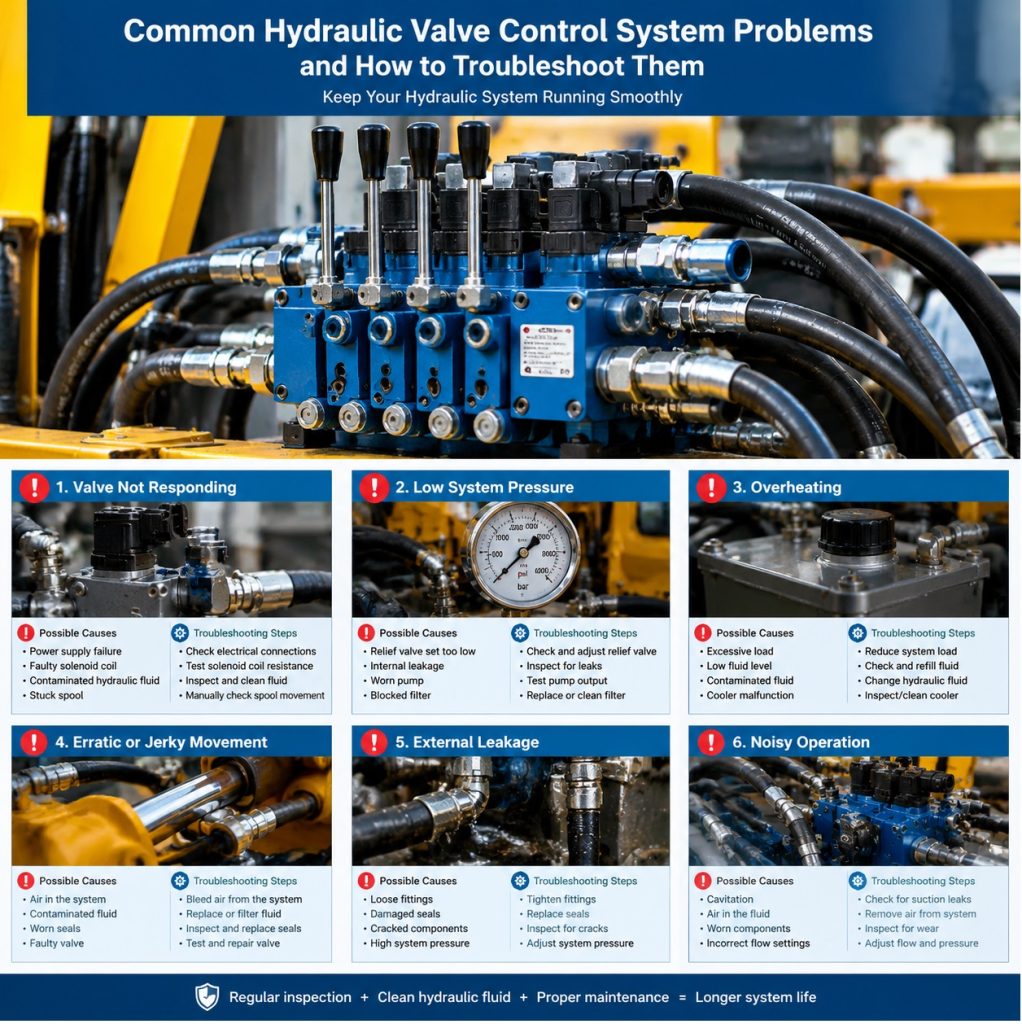
 A stuck valve doesn’t announce itself politely. It gives you a drifting cylinder, a slammed actuator, a pressure spike, or a machine that refuses to move at 2 a.m. while production waits. The good news? Most valve control failures leave clues long before they become breakdowns. The bad news? Too many maintenance teams chase the valve itself when the real problem is upstream, downstream, or inside the signal chain.
Start with the fluid, not the valve. Dirty oil is the quiet killer. A single particle can score a spool, hang a poppet, or clog a pilot orifice. If you see erratic motion, sluggish response, or random pressure drops, pull an oil sample before you touch the valve. Check filter differential pressure. Look for water, air, and viscosity changes. Cold oil can mimic a dead valve. Hot oil can cause internal leakage and drift. If the fluid is wrong, every adjustment you make is a temporary lie.
Then verify pressure and flow. A valve needs the right pilot pressure to shift. If pilot pressure is low, the main stage may never fully open. If supply pressure is unstable, the valve gets blamed for a pump or relief issue. Tee in a calibrated gauge at the valve inlet, outlet, and pilot port. Compare readings to the schematic, not to memory. Flow matters too. A valve rated for 40 L/min will not behave like one rated for 80 L/min just because the threads fit.
Electrical faults are the great impersonators. A proportional valve with a bad coil, corroded connector, or broken ground can look like a hydraulic failure. The solenoid may hum, heat up, or do nothing. The amplifier may send a signal that never reaches the valve. Use a multimeter and a current clamp. Check command voltage, coil resistance, PWM signal, and ground integrity. Wiggle test the harness while watching the actuator. Intermittent faults love cheap connectors and chafed wires.
Feedback and tuning problems cause the weird stuff. If the valve has position feedback, the problem may be a dirty LVDT, a misaligned sensor, or a closed-loop gain set too high. Symptoms include oscillation, hunting, slow response, or a cylinder that overshoots and then creeps back. Do not just crank the gain. Verify feedback mechanically and electrically first. Then tune with a scope or data logger. A valve that is 90 percent correct can still destroy a process if the last 10 percent is unstable.
Contamination and wear create repeat offenders. When a spool sticks in one direction, or a valve leaks internally only when hot, wear is often the cause. You can clean a valve and get it running, but if the contamination source is still there, it will fail again. Look at cylinder rod seals, breathers, hose assembly debris, and reservoir return filters. A proper flush and filtration upgrade costs less than three repeat rebuilds.
Troubleshooting should follow a sequence. Confirm the symptom. Check fluid condition and temperature. Verify supply and pilot pressure. Test electrical command and feedback. Isolate the valve with a manual override or known-good replacement. Inspect internal parts for scoring, varnish, or debris. Log the results so the next failure is faster to diagnose. Guessing is expensive. A logical path is not.
The real fix is often system design, not a single part. If your hydraulic valve control system is running blind, every fault feels like a surprise. Pressure transducers, temperature sensors, filter clogging indicators, and valve spool position feedback turn guesswork into data. A modern control platform can flag a degrading coil, a clogged filter, or a pressure imbalance before the line stops. That is not a luxury. It is downtime insurance.
If your hydraulic valve problems keep coming back, bring in a team that troubleshoots the whole system, not just the part number. The right partner will read the schematic, test under load, analyze the fluid, and tune the electronics. They will tell you whether to repair, replace, or redesign. And they will leave you with a system that runs quieter, cooler, and more predictable. That is how you turn a maintenance headache into a competitive advantage.